The Embedded AI Trio
Ethan Mollick on pulling IT out of IT to build with subject-matter experts - and why, as someone who has been doing this, I have mixed feelings about it.

- David Gérouville-Farrell
- 6 min read
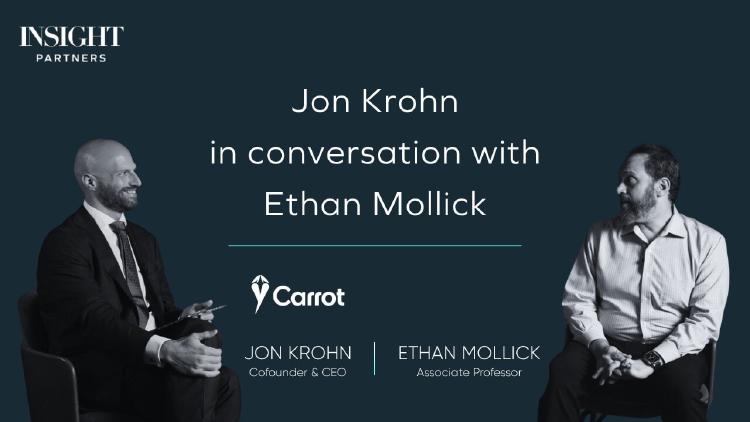
One of my favourite writers on AI isn’t really someone you’d consider an “AI guy.” It’s Ethan Mollick, the Wharton professor of business who wrote one of the first good books about our current AI moment, Co-Intelligence. That book formed the basis of my first AI enablement workshops. What I love about Ethan is that he takes AI seriously without sounding like a sci-fi author. He’s grounded in how real work gets done.
Back in November he was interviewed by Jon Krohn, Co-Founder & CEO of Y Carrot, for Insight Partners. The full interview is here and runs about six minutes.
The framing of the piece is five rules of great AI leadership:
- Choose your mode of human-AI collaboration - work alone, work interactively, assign tasks and evaluate, or hand off to an autonomous agent. Pick the right one for the job.
- Great AI management creates competitive advantage - the wins come from how you organise around AI, not from chasing the latest model.
- AI transformation has to come from within - leadership, lab, and crowd, all internal, with vendors and consultants in supporting roles.
- Incentivise the “secret cyborgs” - over half of workers already use AI quietly. Make it safe to surface what’s working.
- Use advanced models extensively - the only durable preparation for the next wave is hands-on time with the current one.
If you want to dig into all five, go read or watch the interview. What I want to do here is talk about Rule 2, because it’s one I have a little bit of experience with now.
The quote
When Jon asks how executives should be rethinking team structures and management given the rise of AI as a “teammate” rather than a tool, Ethan says this:
Let’s pull senior IT people out of the IT department and have them sit next to a subject matter expert and vibe-code applications together.
It’s a similar pattern to the ones that show up in Deloitte’s Forward Deployed Engineering model, in the Pragmatic Engineer’s coverage of FDEs at Palantir, OpenAI and Ramp, and in Teresa Torres’ product trio framing of cross-functional discovery work.
What it actually looks like
One of my consulting relationships is very much this kind of setup. I’ve been working with a product leader at the client since August, and we’re still doing the same work now. Of the patterns above, what we do most closely resembles Teresa Torres’ product trio. The pattern is: he and I pair up, and we embed into different departments where he has identified there might be workflow efficiencies worth chasing.
You really do need a product person who knows both the AI and the business well, because a lot of what makes the pattern fast is not going through the usual rigorous discovery. They have to cherry-pick the most valuable opportunities without first running a quarter of stakeholder interviews.
What we typically do is spend time with the subject-matter experts and the frontline teams. They show us how they do things. As the AI people in the room, the product lead and I are practically screaming inside about how much AI can help with the things we’re watching. We try to find the least amount of work that delivers the most amount of value, and that usually looks like one sprint - occasionally two - throwing together a quick prototype.
These often start as a Jupyter notebook and frequently evolve into a standalone Azure web app once we want authentication and a real UI. And they almost always involve automating the kinds of tasks that generative AI is good at: understanding unstructured text, bringing structure to it, deciding whether something meets a set of criteria, and writing the result back out into a tidy data format.
A representative example: scraping a set of websites, working out whether a particular paid advertisement was actually displayed on each one, and updating a spreadsheet so the client can see that their ads ran where they were supposed to. The kind of thing that a person could do, but slowly, and one site at a time. There are loads of companies where teams of people are spending hours each day doing this kind of work. It’s not a lot of fun for them, and it’s exactly the kind of thing that AI can do really well.
What’s fun about working this way is how short the gap is between plausible conception and value delivered. These teams are getting hands on the tools in one or two sprints. That’s hard to overstate if you’ve spent any time in traditional enterprise delivery. It’s basically unheard of prior to this moment.
What I find harder about it
A couple of things.
The first is a personal-context problem. Two months will go by, the frontline team will come back with a request to change something, and I’ll find myself returning to a project I only spent one or two weeks on. I’m not exactly vibe coding - I’m steering the architecture, checking it’s safe, making sure the quality is there - but Claude is writing the bulk of the code. The result is that the deep memory I’d have built by typing every line by hand just isn’t there. That’s fine when you’ve done one or two of these. When you’ve done six or seven, and each one was a fortnight two months ago, every return visit feels a bit like coming back to a new project. It’s hard to keep all the context in your head, never mind advise confidently on what’s possible to change.
The second is bigger. There’s an implicit promise in this way of working - that the rapid embedded prototype replaces old-school discovery. Instead of three months of analysis to decide whether something is worth building, you go and build a version in two weeks and find out. As someone who has played product lead plenty of times, I love being able to test hypotheses that quickly.
The downside is that we find value in too many things, too quickly, and it’s hard for the organisation to put in place the rest of the team who would ideally come behind us and rebuild what we made in line with all the usual practices - the proper data pipelines, the integration into existing systems, the documentation, the support model. What happens in practice is that frontline teams start to depend on a bunch of slightly ad-hoc workflows that aren’t really integrated into anything larger.
I worry that, as a community, we might be recreating the spreadsheet problem. Many businesses, regardless of how they’re supposed to work, run in practice on dozens of unofficial, undocumented, unsupported spreadsheets that individual people built for their own purposes and that everyone has come to rely on.
thingsithinkithink
-
I feel a bit weird about the tension between doing things really fast and doing things really well. It’s less about the quality of the code itself and more about the quality of the outer loop - documentation, support, integration into an organisation’s larger roadmap, alignment with intentional strategic direction. But it’s hard to feel too bad about it when everyone is getting tons of value: real time savings, increased revenue, positive feedback. Who am I to say it’s not a good idea?
-
My qualms about accidentally reinventing spreadsheets might be more about my appeal to the aesthetic form of how things should be done than they are about the actual results.
- Tags:
- Ai
- Ai-Leadership
- Consulting
- Product
- Feature