Does It Matter If AI Wrote This?
Some thoughts on AI slop, and on why I was relieved when an AI detector told me I was human.

- David Gérouville-Farrell
- 6 min read
LLMs are so useful that it’s hard not to use them. And yet I hate it when somebody sends me a document that reads like it was written entirely by Claude or by ChatGPT. The signal it sends is that the writer didn’t put any effort into it.
This is not something that’s unique to me. It’s a topic of conversation I find frequently in all the various circles I am connected to. One client’s office has a stance of “no blank sheeting”, and they require all colleagues to do their first draft entirely before asking AI to help with edits. Another organisation I work with suggests that people are allowed to use AI to create things, but they should disclose it. And even extremely AI-savvy and AI-forward authors like Ethan Mollick make a big deal of it.
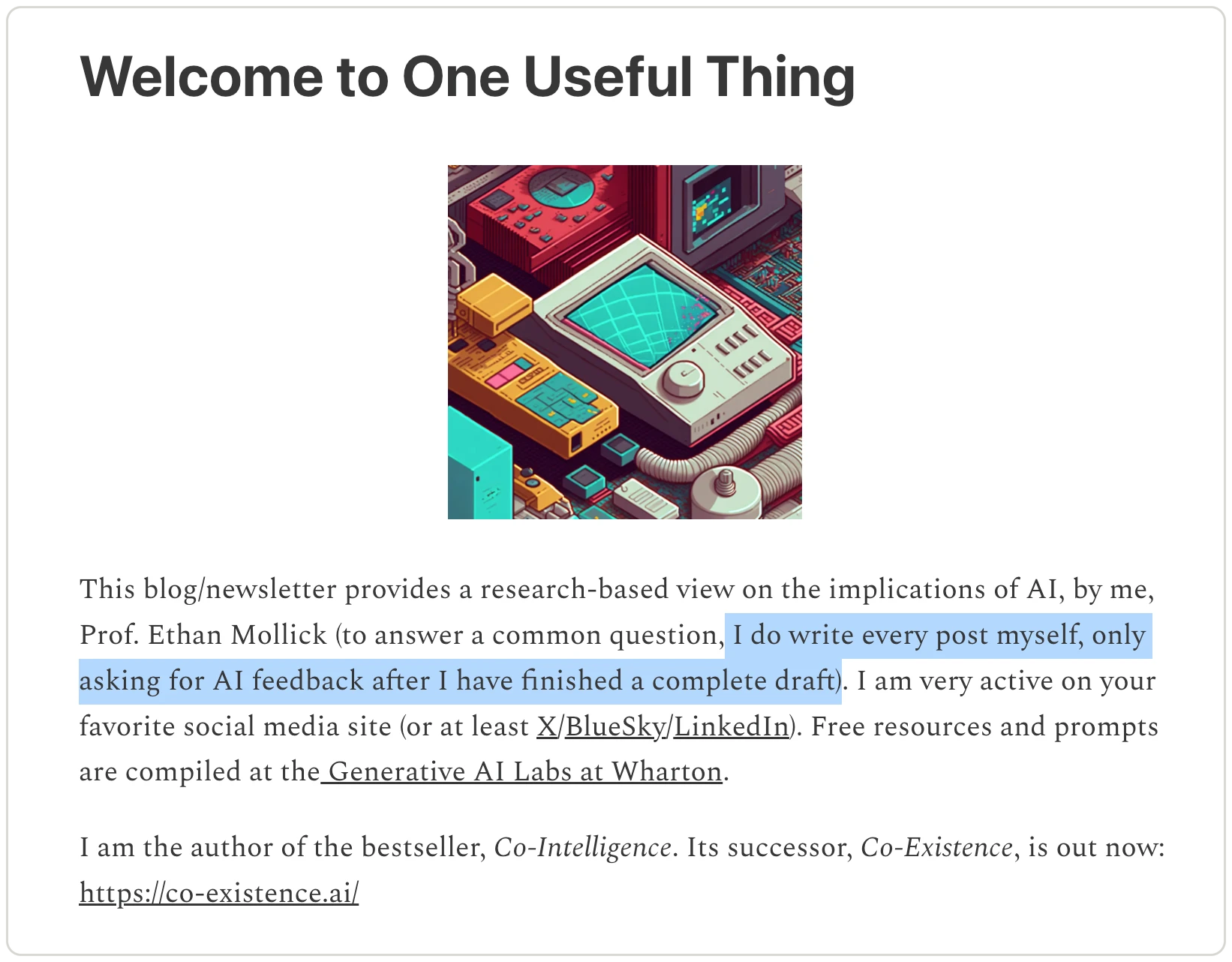
The about page of Ethan Mollick’s One Useful Thing
I think people put a lot of effort into this because the emotional reaction people have to receiving a document that feels like AI wrote it is very negative. I certainly hate all of the AI slop that I’m forced to read (sites like Twitter, LinkedIn and Facebook don’t even count as social media any more, because I’m pretty sure it’s mostly just bots talking to bots).
Here’s a great example. Somebody recently reached out to me on LinkedIn. We all receive these LinkedIn cold-call messages these days, and I do read them, even though I know most of them are slop. I noticed this person was saying that this was not a sales pitch and not an automated message, and that they were writing one-on-one. I thought, that’s an interesting signal to send somebody. You’re telling them that you put effort in. It’s interesting to me that it’s come to this - we have to tell people we’re not automating these. And yet, when I read the actual message, it sure felt to me like it was AI generated. So I copied the message into Pangram, and Pangram gave it a 100% AI score (I pasted the image back to the sender and was subsequently blocked!).
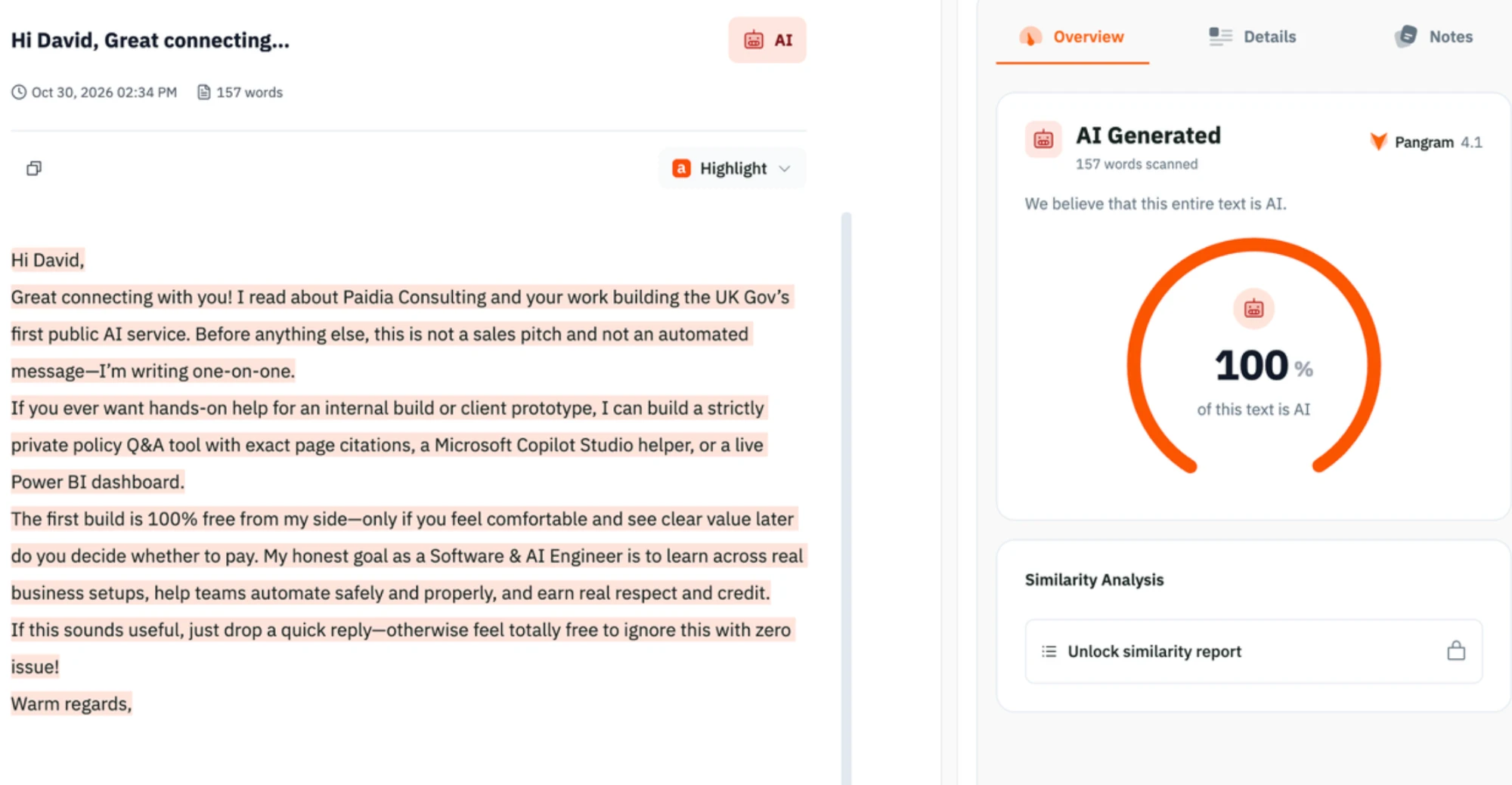
The LinkedIn message in Pangram, with the sender’s name removed
Even in my own professional capacity - as someone who uses AI for almost everything I do - I had a disagreement with a colleague relatively recently because I received a document that gave me the impression of AI slop and really annoyed me.
Right now it feels to me like we’re at a point in time where we are renegotiating the social contract of collaborative work. From any one person’s perspective, AI is really helpful for whatever it is they’re creating. But when somebody else hands you something that feels like it was heavily influenced by AI, it just feels bad. Or as Seth Rosen put it:
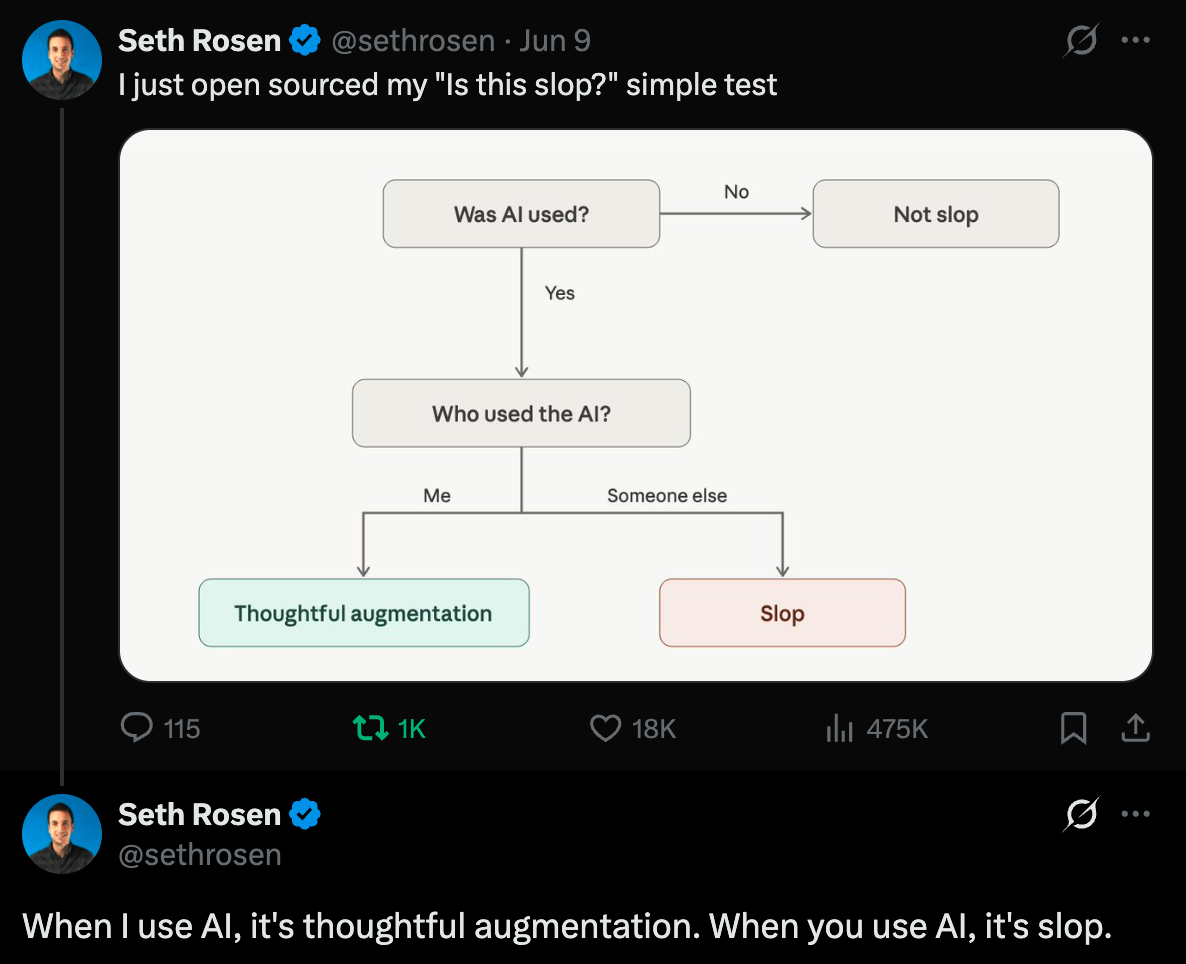
The signals of quality we have relied on for years - that something is articulate, written well, structured well and, on a surface reading, thorough - are no longer effective. AI slop and high quality, highly opinionated AI-supported work may look the same due to the AI tics and quirks.
It’s got me reflecting on the way that I like to use AI. I’ve certainly felt a concern that people would dismiss my work if they felt I was leaning on AI too much. And yet I use extraordinarily large amounts of AI for pretty much every single thing I do. These days I barely leave my AI windows. I don’t write blog posts in WordPress or in a custom tool like I used to - I write them in Claude. I don’t write code in an IDE. I don’t make my diagrams by dragging nodes around and connecting vertices. All of my work is funnelled through an AI interface these days. And yet it still feels to me like highly specific, opinionated, powerful, personal work.
Due to the recent emergence of tools like Pangram, which seem to have at least temporarily won the war against disguised AI writing, I have been wondering whether my own AI-supported work would be dismissed by others as slop.
So I was admittedly relieved when I put my last blog post through Pangram and received a 100% human score.
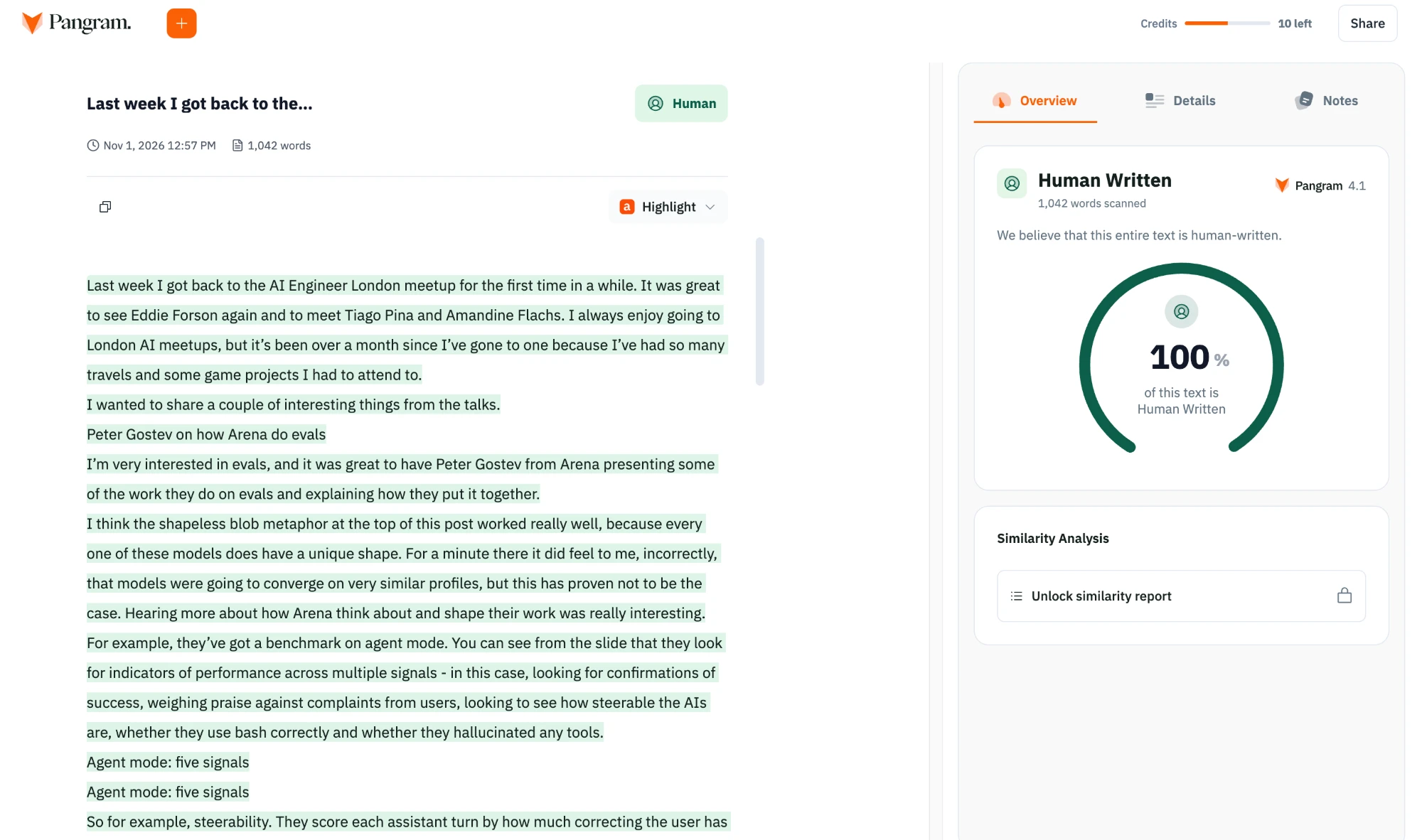
My last blog post in Pangram: 100% human
I don’t like that I was relieved. I did use a lot of AI for that post, and the way I use AI feels to me like an appropriate and actually good way of using it. So this is not a correct score. 100% is not true. What is true is that it’s extremely me in that post. But I did use a lot of AI, and some of the words were definitely written by AI.
How do I square my comfort in using a lot of AI, and my confidence in the work I’m doing, with the fact that I feel emotionally relieved that it doesn’t look to an AI detector like I used AI? I feel like this friction between two contradictory feelings tells me there’s work to be done to redefine what we care about. I don't really care if something was written with AI. I care if it was written well, and if the person who wrote it stands behind it and believes in what they wrote.
I will describe my exact process in some future post, but the short version is that I use Superwhisper and essentially dictate a long-form post to myself, with several contradictions and backing up and rephrasing things and going down rabbit holes and asking my AI to fact-check things and help me with the wording on this sentence. I essentially just spend an inordinate and perhaps unreasonable amount of time talking to myself, and then I ask AI to help clean it up and edit it and turn it into a post. So it is definitely personal and definitely opinionated and specific to me, and that’s what I believe in and what I care about. But it’s also using AI to turn my ramblings into a coherent article.
And I’m happy to see the 100% human score, not because it’s true, but because for the time being it acts as something of a sign of quality.
thingsithinkithink
-
The Superwhisper dictation for this post was about 15 minutes of me talking to myself before sending anything into Claude.
-
(This post also gets a 100% human!)
- Tags:
- Ai
- Writing
- Ai-Leadership