Why a 9-Year-Old Uses AI Better Than Most
How to get brilliant at your job with AI, no formal training needed.

- David Gérouville-Farrell
- 4 min read
“Create an app all about dinosaurs. Uh, yeah, dinosaurs.”
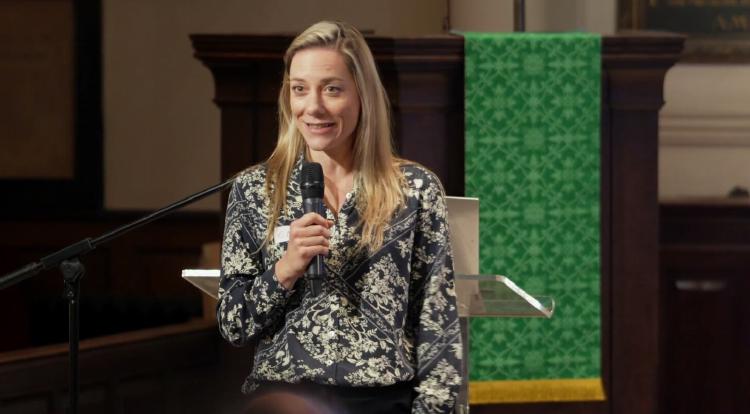
That’s the start of a prompt that Emma Lancia’s nine-year-old spoke into Lovable. Emma, who runs Big Leap Change, showed it to us in a talk at a Mindstone meetup in London last week. She was the highlight of the evening for me. I absolutely loved her talk and her energy was impeccable.
She’s an occupational psychologist, and she has spent most of her career on how technology can help people be brilliant at work. She used to get brought in when a company had paid millions for something like SAP or Workday and everybody hated it. When generative AI arrived, she thought people wouldn’t need that help any more, as everyone could now solve their own problems.
That hasn’t happened. In fact, even though nearly everybody in the room was using AI, a PwC survey shows only about 19% of UK workers use AI in their jobs every day.
She’s been thinking about why people don’t use AI and has come across three different attitudes in the people who don’t use it every day. The negative ones tried it and it was a bit rubbish. The neutral ones don’t really know how it could help. And the positive ones know they should and will get round to it, but first they need to spend two hours copying numbers from a PowerPoint into Excel.
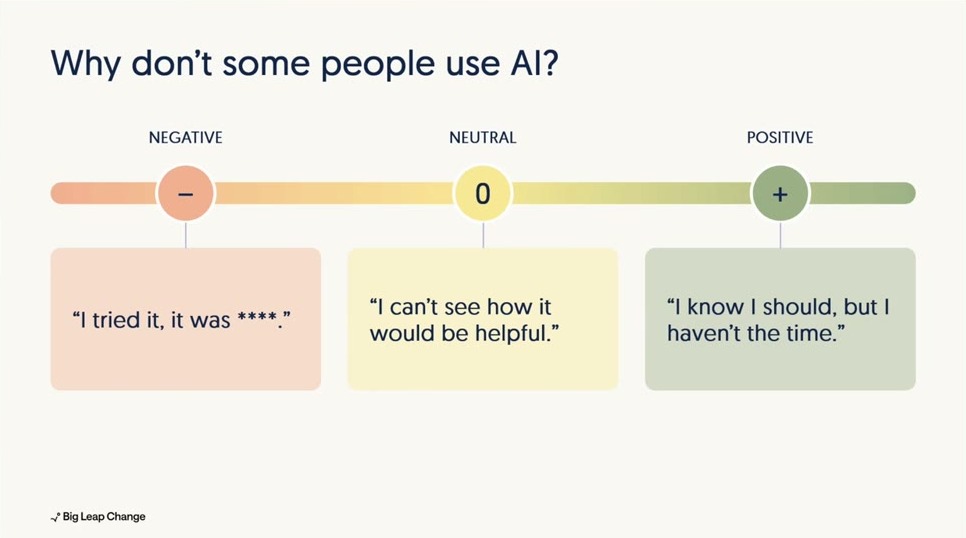
Emma’s three attitudes
She notices that companies usually respond to this by just buying everybody licences. Then, if people don’t use the licences, they send them on training. However, most AI training is terrible.
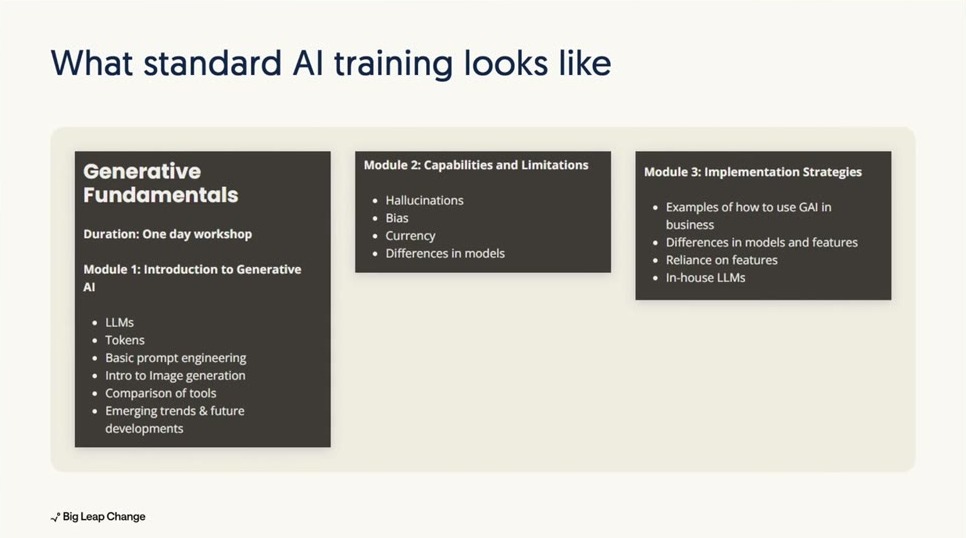
What standard AI training looks like
I can definitely attest that this is what I find in most companies I work with. Their AI training is almost as boring as their cybersecurity or know your customer training.
Emma points out that people don’t get much value from spending a day learning what tokens are, what LLMs are and how models differ, because it doesn’t really impact their behaviour. People get value from AI when they ask it to do something and it succeeds in doing that thing.
She contrasted the typical training programme with the way her nine-year-old speaks to Lovable.
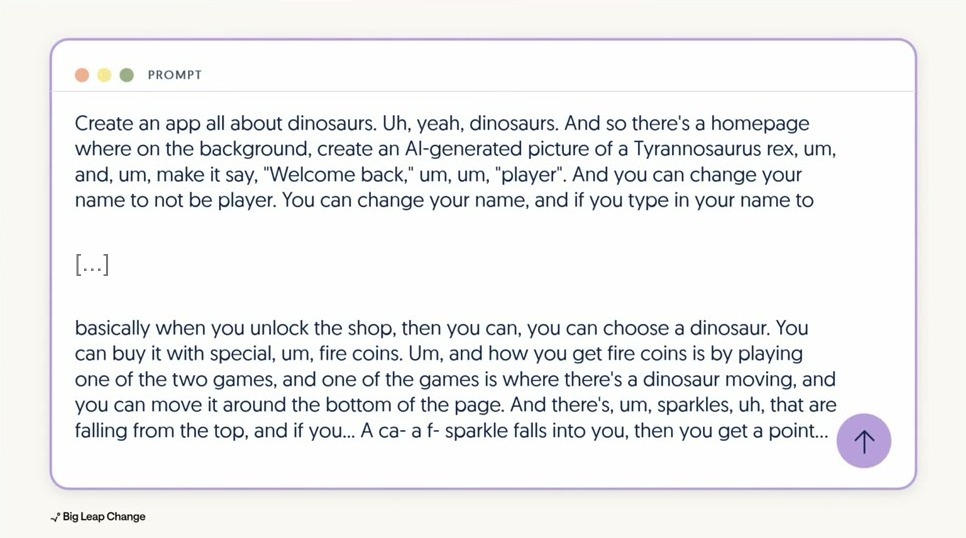
Her nine-year-old’s spoken prompt (I’ve trimmed a few lines)
As you can see above, it’s an incredible prompt. Her nine-year-old is communicating exactly what she wants. She goes back and forth a few times until she’s happy with the quality of work the AI produced, or until she runs out of tokens - which is how she found out what tokens are, when she asked her mum why the tool had stopped working. She did all that without receiving any formal training.
This really spoke to the audience, and it shows exactly how you get excellent at using these tools. You use them for stuff you’re motivated to do, solving problems that you have, and you pick up theory as you go, just like her daughter did with tokens.
Emma’s answer for the grown-ups is the same. She thinks what’s stopping them is inertia (she’d started her talk by making us all stand up, to show how hard it is to move once you’re settled), so you have to get them to try it, and on something that matters to them. If you’re too busy copying numbers into Excel, let’s use Copilot to do that. And to find what matters, she asks what being brilliant at your job looks like. For a water company it was keeping track of versions of their manuals. For a climate charity it was matching people who have funding with people who have ideas. She said that in all her innovation work nobody ever told her they needed a tool to write their emails.
I think this is spot on for the people she described. But I also encounter a lot of folk who would go into her negative category for values-based reasons. They have a relatively strong dislike of the companies that have invented these technologies, and of the potential impacts on many of the things they care about in the world, like their jobs, their communities and the arts. These are really valid positions, I think, and I understand them. I don’t know that not using AI is the right way to deal with them.
That resistance is part of what I find, and I don’t think it’s as easily overcome as it is with people who just think AI isn’t capable enough. If somebody tried it and it was rubbish, you can sit down with them and show them it working on their problem. But if somebody is worried about what it’ll do to their job or to the arts, showing them how well it works isn’t going to help much.
thingsithinkithink
- I do lots of similar work to what Emma does, helping organisations get value from their AI tools, and I’m definitely going to steal “what does being brilliant at your job mean?”
- Tags:
- Ai
- Ai-Adoption
- Training